

Scenario: you’re sitting at a laptop in New York, you have an idea about a macro inflection, and you want to short Ethereum using perpetual swaps on OKX. The price is moving fast and your phone buzzes—your OKX account is locked pending verification, or two‑factor codes are delayed. This moment crystallizes the everyday friction every US-based trader faces: access and execution matter as much as strategy. The remainder of this article uses that concrete case to unpack how OKX’s futures work, what controls and exposures sit between your idea and its real-world outcome, and which pragmatic steps reduce the chance that access problems or platform mechanics turn a good thesis into a poor trade.
We will cover three linked layers: transaction plumbing (how futures are constructed and settled on OKX), account and login mechanics that determine your ability to act, and the operational trade-offs (liquidity, margin, and custody) that define realistic risk. The goal is not to sell OKX but to give you a reusable mental model: when to prefer perpetuals vs. quarterlies, how leverage amplifies not only returns but operational fragility, and what to watch in the short run given recent exchange housekeeping like periodic delistings.
1. How OKX futures work: mechanism first
At the mechanistic level there are two derivatives most traders use on OKX: perpetual swaps and quarterly (or other dated) futures. Perpetuals mimic spot exposure but use a funding-rate mechanism to tether the contract price to the underlying index. That funding rate periodically transfers small payments between long and short holders; if longs dominate and the perpetual trades above the index, longs pay shorts, and vice versa. Quarterlies instead settle on a fixed date and embed carry into price rather than periodic funding.
Why this matters: funding makes perpetuals cheaper for short-term directional bets because you avoid contango or backwardation baked into dated contracts, but funding can swing quickly during crowded moves, imposing recurring costs or income that materially changes position P&L. Quarterlies reduce that intra-period transfer noise but expose you to expiry considerations—roll costs, gap risk at settlement, and sometimes lower liquidity near expiry.
Mechanics: OKX offers up to 125x advertised leverage on select perpetuals. That is not an endorsement to use maximum leverage; mechanically, leverage compresses the margin buffer and magnifies sensitivity to funding, index divergence, and slippage. Liquidation is automatic if maintenance margin falls short—on OKX this interacts with both cross-margin and isolated margin modes. Cross-margin can protect a single position using your entire account equity at the cost of exposing all balances; isolated confines risk to the allocated margin but can be wiped out quickly.
2. Access, verification, and the practical login path
Your ability to access those tools is gated by account mechanics. OKX in practice is a hybrid: a centralized exchange with a non‑custodial Web3 wallet and a broad DeFi hub. For US-based users, identity verification (KYC) is mandatory to open most derivatives permissions; the process requires government ID and a facial liveness check. These steps are compliance constraints but also friction points—failed liveness checks, mismatched ID data, or delays in document processing can turn a nimble trade idea into a missed opportunity.
Two practical log-in details matter: multi-factor authentication and platform routes. OKX supports mandatory Two-Factor Authentication via SMS, Google Authenticator, and biometric options on mobile. It also has high-grade encryption and AI-driven detection for suspicious logins. If you’re moving fast, use the most reliable 2FA you can operate under friction (hardware tokens or an authenticator app), and register device biometrics on the mobile app as a fallback. If you need to re-establish access, OKX’s web portal and mobile app are primary paths; browser extensions are convenient for Web3 interactions but should not be your sole recovery route. For a step-by-step access page and to start the login flow, see this OKX login guide: okx login.
Limitation and risk: losing access to a self-custodial seed phrase on the Web3 wallet is permanent. Conversely, centralized balances on OKX benefit from institutional controls like Proof of Reserves transparency and cold storage that places over 95% of assets offline using multi-signature approvals. That reduces systemic custodial risk but does nothing to prevent phishing or account takeovers driven by weak 2FA or social engineering.
3. Liquidity, slippage, and the anatomy of execution
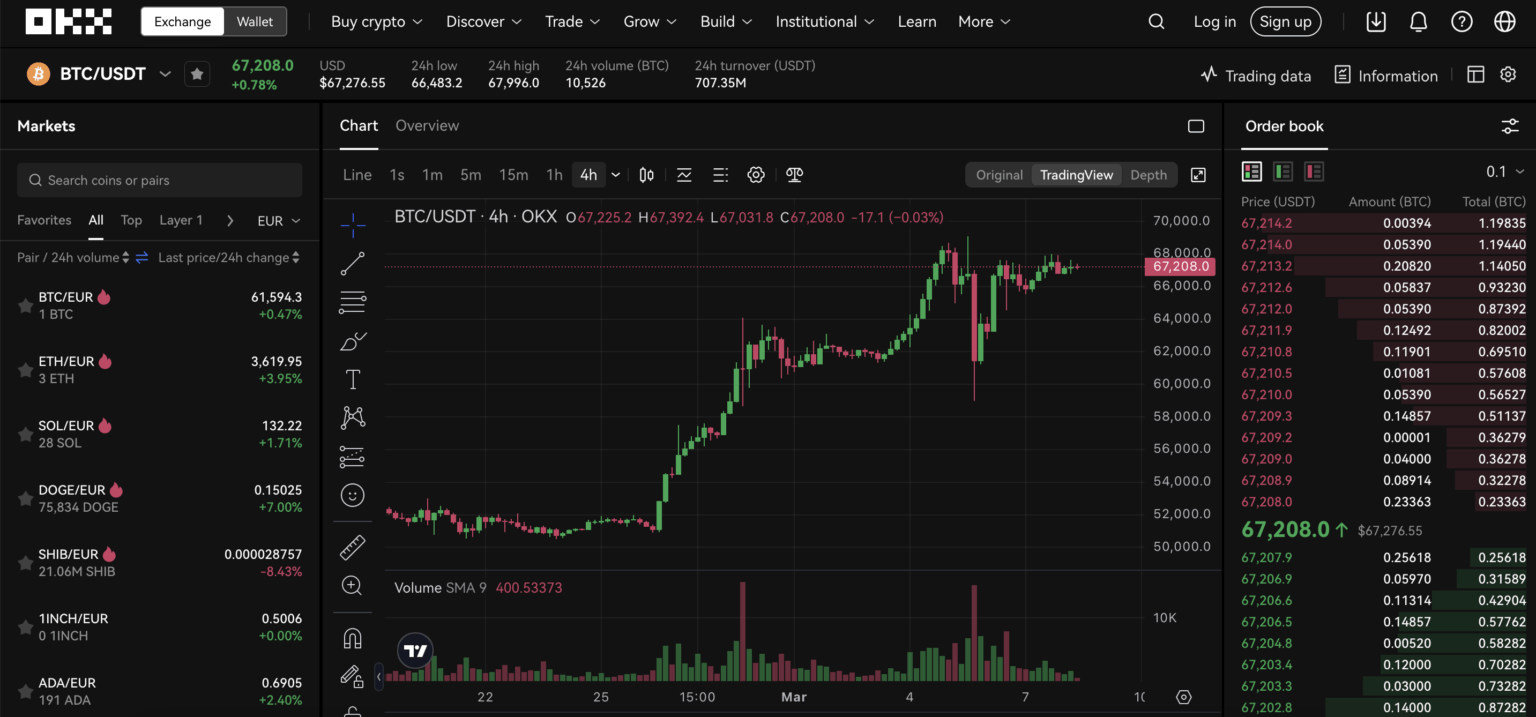
Execution is the bridge between idea and P&L. OKX supports advanced TradingView charting and order types; that helps, but mechanics still boil down to order book depth, tick size, and latency. Futures on major pairs (BTC, ETH) generally have tight bid-ask spreads and deep liquidity; exotic tokens or recently delisted assets show the opposite. The recent delisting of several spot pairs—part of routine exchange maintenance—illustrates a trivial but important point: the platform periodically prunes markets to preserve liquidity and compliance. For traders, this means reliance on large, liquid futures markets is safer than chasing marginal spot tokens that may be removed or suffer thin order books.
Slippage risk escalates when markets move fast. Perpetual funding rates can spike, and liquidity providers may withdraw capital, widening spreads. If you’re running high leverage and the market gaps, liquidation systems will sell into that widened spread, exacerbating price moves. That’s a classic positive feedback loop in derivatives markets: deleveraging begets worse prices, which begets more deleveraging. Traders must plan for this mechanically—use staggered exits, limit orders where appropriate, and keep a measured maintenance margin buffer.
4. Custody trade-offs: centralized convenience vs. self‑custody control
OKX combines centralized custody for exchange trading and a non-custodial Web3 wallet. The trade-off is clear and quantifiable. Holding assets on OKX simplifies margining, funding, and quick order execution; you also benefit from Proof of Reserves and multi-sig cold storage. But centralized custody introduces dependence on the exchange’s operational health and KYC controls. Self-custody gives control and reduces counterparty exposure, yet it shifts complete responsibility for key management to you. In the context of futures, being entirely self-custodial typically precludes using centralized margin and derivatives—so the trade-off is between product access and absolute custody control.
Decision heuristic: if your strategy requires fast entry/exit and leverage, central custody on a regulated, proof-backed exchange is usually necessary. If your priority is long-term holdings and composability with DeFi, use the self-custodial wallet and accept that derivatives exposure will be limited or require bridging steps that carry gas and counterparty risk.
5. A sharper mental model for risk allocation
Think of capital allocation across three “buckets”: operational buffer, margin capital, and strategic reserves. Operational buffer is liquid, low-risk capital you keep to cover margin calls and avoid forced liquidations when price moves against you. Margin capital is the portion you commit to active leveraged positions—the smaller and more stressed your view, the less leverage and the larger the operational buffer you should maintain. Strategic reserves are longer-term holdings that stay outside margin entirely (ideally split between cold storage and a self-custodial wallet).
Why this helps: when you model trades using this three-bucket approach, it clarifies decisions like whether to use isolated or cross margin. If you keep a large operational buffer, cross-margin may be acceptable because you can tolerate temporary drawdowns without triggering full-account liquidations. If your margin capital is tight, isolate positions so one bad bet doesn’t consume unrelated holdings.
6. What breaks, and what to watch next
Known failure modes are practical: login/2FA failures, sudden funding-rate spikes, liquidity evaporation, smart contract exploits if you hedge by routing through DeFi, and policy-driven delistings. Last month’s removal of several small spot pairs is a reminder that exchanges actively manage listings; while routine, delistings reduce optionality for traders holding niche tokens.
Signals worth monitoring (conditional alerts, not certainties): sustained abnormal funding rates (indicates a crowded side), widening spot–perpetual basis (signals liquidity stress or arbitrage opportunity), KYC processing delays in your jurisdiction (affects access), and exchange transparency moves (Proof of Reserves updates, multi-sig changes). Each signal should trigger a defined operational response in your trading playbook—top-up margin, reduce leverage, or move strategic reserves to cold storage.
FAQ
How quickly can I start trading OKX futures after creating an account?
Practically speaking, basic account creation is fast, but derivatives access in the US usually requires completing KYC (ID and liveness check). Processing times vary; plan for delays and avoid assuming instant access for time-sensitive trades. Meanwhile, set up robust 2FA and register device biometrics to reduce friction when you do have access.
What is the safer way to use leverage on OKX: cross-margin or isolated margin?
Neither is universally safer; each suits different priorities. Cross-margin leverages your whole account to avoid isolated liquidations but exposes more capital if things go wrong. Isolated margin contains losses to one position but can be wiped out quickly. Use cross-margin only if you maintain an operational buffer and can tolerate temporary drawdowns; otherwise prefer isolated with conservative leverage.
Can I use my self-custodial OKX wallet to trade futures directly?
No. The non-custodial Web3 wallet gives you private-key control for on‑chain DeFi and NFT interaction but does not directly offer centralized derivatives trading. To trade futures, you need a funded account on the centralized OKX platform and the appropriate permissions enabled.
How should a US trader prepare for platform delistings or market pruning?
Treat delistings as part of normal exchange housekeeping. Avoid over-concentration in marginal spot pairs you cannot readily liquidate; keep a list of exit routes for less-liquid holdings and monitor exchange announcements. For futures traders, prioritize well‑listed, high‑liquidity contracts.
Takeaway: the path from idea to executed futures trade on OKX is as much an operational problem as a market one. Understand the funding mechanics behind perpetuals, pick margin modes aligned with your buffer, secure login methods so access doesn’t fail you, and maintain a decision rule for when to reduce leverage. Watching funding rates, liquidity spreads, KYC processing status, and exchange notices will keep you in the loop—each is an actionable signal, not a prophecy. Trade design and platform readiness must be solved together; risk appears when one is ignored in favor of the other.