

Here’s a counterintuitive claim to start: the most useful security feature in a wallet for active DeFi users is not cold storage or multisig by itself, but the ability to simulate and meaningfully explain a transaction before you sign it. That is the claim I will defend and unpack using Rabby Wallet as a case study. For traders, liquidity providers, and contract-heavy power users, small mistakes in approvals or blind signing are the highest-frequency source of loss. Rabby’s transaction-simulation-first design reframes those losses as an avoidable class of operational risk rather than an inevitable cost of doing business.
This article walks through how Rabby’s mechanisms work, where they materially change decision-making, how the wallet compares to mainstream alternatives, and where the tool still leaves a security gap. My goal is practical: give you a mental model for when to prefer Rabby, what to watch during install and daily use in the US context, and what trade-offs you accept when you adopt it.
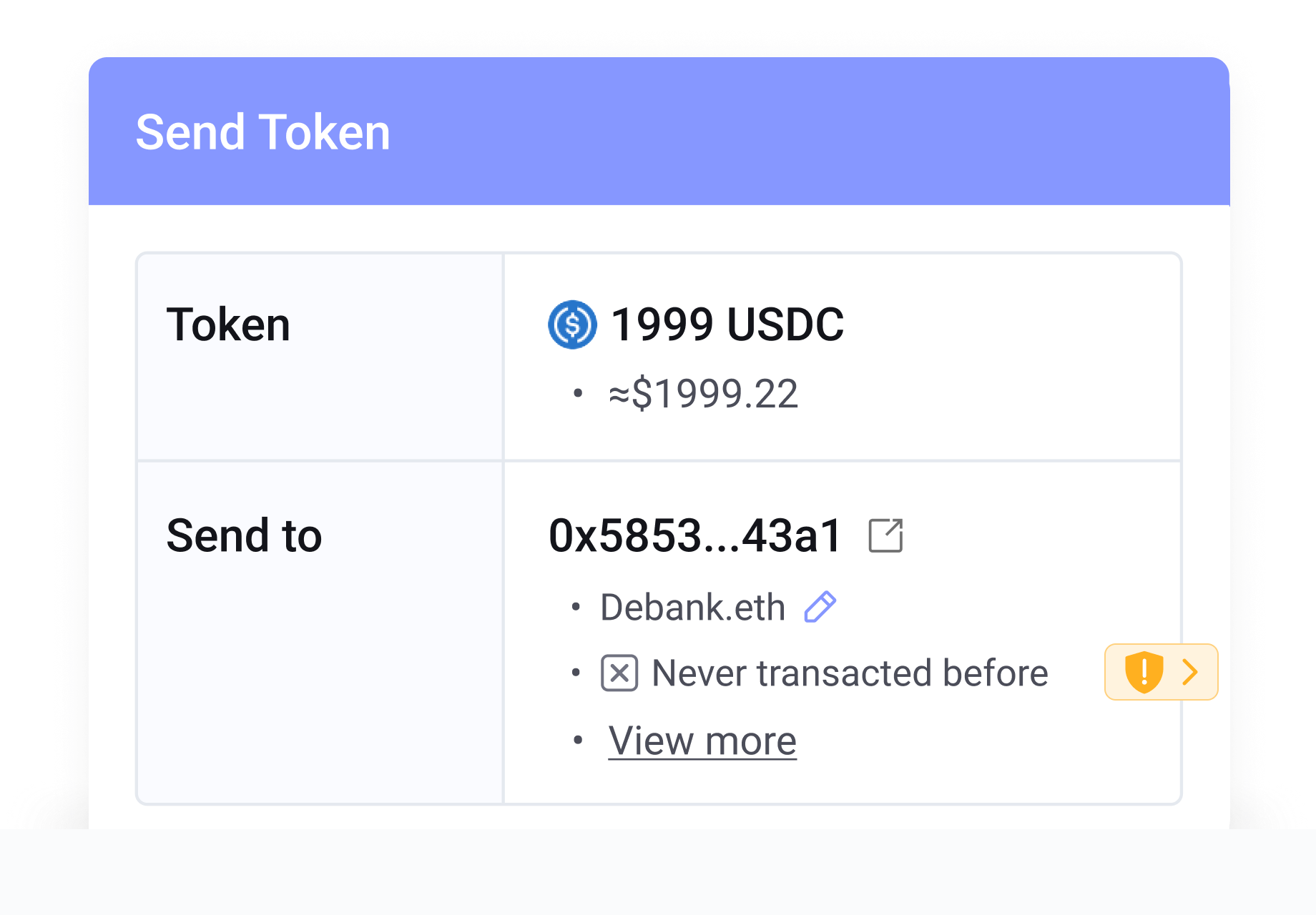
Mechanics: how Rabby makes a transaction visible
At the mechanical level, Rabby is a non-custodial, multi-chain browser and mobile wallet built by DeBank and released under an open-source MIT license. Two linked mechanisms are central to its promise for power users: transaction simulation and pre-transaction risk scanning.
Transaction simulation means Rabby executes a dry-run of the transaction against a local or remote EVM node to estimate exact token balance changes and gas costs before the user signs. That simulation surfaces outcomes that raw calldata cannot convey to a human: token inflows/outflows, the net effect on a token balance after slippage and fees, and the actual gas units paid. In practice this reduces “blind signing,” where users approve ABI-encoded calls without an understandable preview.
Pre-transaction risk scanning complements the simulation by checking transaction targets and approvals against blacklists, known exploited contracts, and heuristics for suspicious behavior (for example, unusually broad ERC-20 approvals or zero-address recipients). The result is an operational workflow where a user sees both the simulated pull on their balances and a contextual warning if the recipient or contract raises a risk flag.
Where that mechanism matters in practice
For a US-based DeFi power user who frequently interacts with permissionless markets and cross-chain bridges, these features change three everyday decisions:
1) Approval hygiene: Many hacks exploit perpetual or infinite token approvals. Rabby’s pre-transaction checks plus a built-in approval revocation tool make it straightforward to spot and cancel large, persistent approvals—lowering exposure without changing protocol-level risk.
2) Cross-chain friction: Rabby supports over 90 EVM chains and includes a cross-chain gas top-up. That reduces operational errors where a user, for example, tries to execute a trade on Arbitrum but has no ETH on that chain to pay the fee. Automatic network switching also prevents the common mistake of signing a transaction on the wrong chain.
3) Complex interactions: When composing multi-step DeFi flows (zap contracts, layered DEX routes, bridged swaps), simulation translates ABI complexity into a human-understandable ledger of token movements. That helps operators validate the intended economic effect before signing—especially valuable when gas and slippage interact in tight arbitrage windows.
Comparing Rabby with MetaMask, Trust Wallet, and Coinbase Wallet
Rabby sits in the same category as MetaMask, Trust Wallet, and Coinbase Wallet but deliberately optimizes different trade-offs. MetaMask is ubiquitous and well-integrated across dApps; Trust Wallet focuses on mobile and broad asset support; Coinbase Wallet emphasizes a consumer-friendly onboarding path. Rabby, by contrast, trades some initial simplicity for stronger pre-signing visibility and operational controls.
Three comparison points matter for power users:
– Visibility vs. ubiquity: MetaMask’s ubiquity means many dApps assume it as the default; Rabby’s ‘Flip’ toggle helps with compatibility, but Rabby adds extra confirmation layers that can slow high-frequency workflows. That is a conscious trade-off: fewer mistakes at the cost of slightly longer interaction time.
– Institutional integration: Rabby integrates with Gnosis Safe and enterprise custodians (Fireblocks, Amber, Cobo), which makes it easier to scale the same workflow into multisig or custodial setups. This is a strength relative to purely consumer wallets, though multisig still requires policy discipline outside the wallet.
– Security posture: Rabby’s open-source code and simulation engine let independent auditors and users inspect behavior—an advantage for transparency. However, openness is not a defense by itself; as Rabby’s 2022 smart-contract exploit shows, protocol-level components (like a swap contract) can still be attacked. The right mental model: wallet-level simulation reduces operational signing errors; it does not immunize you from contract-level vulnerabilities or exploit vectors outside the wallet’s scope.
Limits, trade-offs, and realistic threat models
No single wallet fixes all risks. Rabby materially reduces blind signing and permission creep, but there are clear boundary conditions:
– It does not replace sound counterparty or contract due diligence. Simulation shows effects given current on-chain code and state; it cannot predict latent bugs or deliberately obfuscated malicious logic hidden beyond what the EVM execution reveals at simulation time.
– Rabby lacks an in-wallet fiat on-ramp and native staking. For US users who prefer on-ramps inside a single app, this adds friction and the need to move assets between custodial exchanges and the wallet. Similarly, if you want to manage staking across protocols from one pane, Rabby currently requires external UIs.
– Hardware security remains critical. Rabby supports Ledger, Trezor, Keystone and others, and pairing with hardware devices is a recommended best practice for high-value accounts. Simulation helps validate transactions that are forwarded to a hardware signer, but the hardware device remains the final root of trust.
Installation and adoption: pragmatic checklist for power users
Installing Rabby in the US context should be treated as a small operational project, not a casual click-through. Practical steps to reduce mistakes:
– Use official sources and verify the extension or app package. Rabby is open-source; check the vetted distribution channel and be cautious of copycat extensions.
– Pair with a hardware wallet when moving significant balances or granting long-lived approvals. Keep a minimal daily-risk hot wallet for frequent small trades and a cold or multisig wallet for large reserves.
– Configure the revocation tool and run it after any large or new approval. Consider setting time-limited approvals where possible to minimize window-of-exposure.
– Enable simulation and familiarize yourself with the output: look for net token deltas, unexpected fee calculations, and any red-flag warnings before you press confirm. The simulation will not catch everything, but it will catch many of the most common and most damaging user errors.
If you want an authoritative pointer to download and verify the client, you can find official install resources here.
Forward-looking implications and what to watch
Transaction simulation seems like a straightforward engineering improvement, but its broader implication is behavioral: as more wallets surface machine-checked previews, the baseline of acceptable operational hygiene shifts. Expect three conditional scenarios to monitor:
1) Normalization: If simulations become standard, attackers will adapt by designing exploits that only reveal malicious behavior at runtime or by combining social-engineering to convince users to bypass previews. Watch for patterns where dApps attempt to obscure intent at the UI layer.
2) Composability pressure: Wallets that simulate complex flows across chains will need robust, shared standards for describing simulated outcomes. Interoperability between wallets, dApps, and analytics providers could create a small standards market—watch for open formats and audit tooling to emerge.
3) Institutional uptake: Integration with multisig and custody providers could push Rabby-style features into enterprise tooling, changing how treasury teams enforce approval policies. This is plausible but conditional on institutional UX and regulatory compliance improvements.
FAQ
Q: Does Rabby prevent smart-contract exploits?
A: No. Rabby reduces user-level operational mistakes by simulating transactions and flagging risky approvals or known exploited contracts, but it cannot eliminate protocol-level vulnerabilities. The 2022 Rabby Swap exploit demonstrates that contract-level security remains an independent risk and requires audits, timelocks, and conservative economic design.
Q: Is Rabby safe to install in a US environment and integrate with hardware wallets?
A: Yes—Rabby is accessible as a browser extension, mobile app, and desktop client, and it supports major hardware devices. For US users, the recommended practice is to install from official channels, pair with a hardware signer for high-value keys, and keep a small hot wallet for day-to-day operations. Openness of the codebase makes independent audits possible, which is a plus for institutional compliance conversations.
Q: How does Rabby’s cross-chain gas top-up work and why is it useful?
A: The cross-chain gas top-up lets you send native gas tokens (like ETH or BNB) to an address on another EVM chain so you can pay transaction fees there. That reduces the operational failure mode where you sign a contract call but lack the chain’s native token to complete it. It’s particularly useful for active traders and arbitrageurs who bounce across L2s and sidechains.
Q: If I currently use MetaMask, what do I lose or gain by switching to Rabby?
A: You gain richer transaction previews, automatic network switching, and built-in approval revocation. You may lose some frictionless compatibility in edge-case dApps that assume MetaMask-specific behaviors, though Rabby’s Flip toggle eases that transition. Expect slightly longer confirmation workflows in exchange for higher visibility and fewer blind-sign errors.
Decision-useful heuristic: treat wallets as risk-control layers, not single points of failure. Use Rabby for its simulation and approval controls to lower day-to-day signing risk, pair it with hardware or multisig for custody, and maintain off-wallet policies (due diligence, monitoring, timelocks) to address contract-level and economic risks that a wallet cannot fix. That combination—good tooling plus institutional discipline—is the practical path to operating securely in DeFi today.